Wednesday, 20 March 2019

LET’S THE MUSIC GRoOVE…. SHALL WE?


Hey guys !!
Today’s post will be about one of the most interesting subject… MUSIC!


Music has always been a point of connectivity between human beings. People want to know what other people are listening to — especially when you are part of a group. 
Do you remember that party at your friend’s house when someone took the computer to put his favourite song? Yes, the song that you liked and asked for the reference…This is what I’m talking about. 
Now, If I ask you the best platform to listen music, keep and share songs among people.. what will you answer?? — as an active member of the community #Spotifycommunity— Let me guess.. Spotify right?


             Résultat de recherche d'images pour "spotify premium"          


Music streaming has become a very dominant trend worldwide mostly due to device and communication shift trends. Nowadays, smartphone is the most convenient way to listen music, watch videos, read online articles everywhere, anytime and especially when you get bored - in public transports for example. The purpose of a mobile phone isn’t to pass phone calls anymore.

As a strategy Spotify used a Freemium model in which they offer 2 services — the basic service of online streaming ; where they earns on advertisement to deliver a free service.  And — the premium account where more features are available ; the customer pay for the usage and don’t have to listen to advertisements.


As per say Spotify target 2 segmentations :


  • #Us  The young community — that are seeking free or affordable prices platforms to sign in and settle all our favourite songs. We love to listen music everywhere, be aware of new trend artists and share our best musical discoveries with some friends.
  • The advisers — that segment foster Spotify to deliver a freemium model that allows subscribers to enjoy unlimited free music. 


How Spotify creates interest among the Spotify community and encourage them to subscribe to the premium service?


The challenge with the Freemium model is to know how much you can give out for free.  If you  give out too much features for free, without any inconveniences, no one will be willing to pay for a premium version. While, If the price is considered too expensive, by the target audience, they won’t subscribe at all. In 2015, the issue with Spotify was that only 25% were premium users, that’s why the company settled lower prices for students in order to give them an incentive to subscribe to the premium version. While in 2018, a fiscal report from Q1 2018, announced that Spotify finished the quarter with 75 million Premium Subscribers and 170 million monthly active users. A user base of 75 million paid subscribers that represents a 45% increase within the last year.      


Why users are more willing to choose Spotify among other stream music platforms ?
Spotify starts with a free service to engage its target to sign up and familiarise them with the application and the offer. Then, as a frequent user, you start building a consequent playlist with all your favourite songs. Here come Spotify’s drawbacks… sometime, you feel listening a certain type of music and you don’t want to be bothered by the adds. However, that is not possible with the free service. So you’re thinking about subscribing to the premium offer and here comes the customer value proposition of Spotify premium. The added value of the premium service possesses unique features as you can follow friends, brands and influencers, share on social media, and discover new music regularly. Users can also save their songs under their account to listen to them on offline mode. 
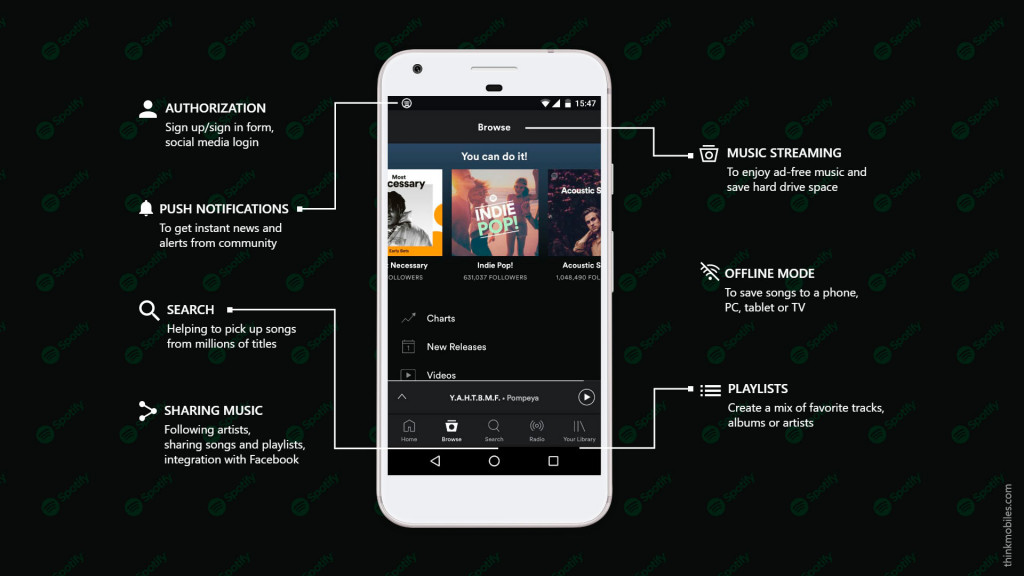
                     Spotify app features, how to make a music streaming app                     
Spotify offers its newness, accessibility and convenience for the end user to stream online music for a short set of time.Therefore, Spotify created a new market for customers by offering access to a whole database of songs at a low price instead of offering songs or albums at a higher price like iTunes that didn’t impact the market. 
           
Image associée
(Jeff DUNN, Business Insider Australia, 2016)
                         
                          Apple Music vs. Spotify


Do you reckon Spotify will last ? Especially when students won’t have discount anymore ? 


Will they stay on the platform, quit definitely or go back to the free service delivered by Spotify ? 


Wednesday, 13 March 2019

When social media impacts our life ...


Social Media are in constant evolution, growing fast and gather more users throughout the years.  Businesses use those platforms to pass messages through active posts and several other digital tools in order to engage people to follow their brand and stick to their mind. While a consumer comments, rates and reviews in order to find the right product or service that will fulfil their needs or wants. 

If social media appears like a fast solution to communicate to users and creates opportunities for businesses, it might also highlight some threats. Hearsay, for example can get viral easily. This can benefit or harm companies. Such as the Coca Cola and Mentos video that created good buzz around the famous soda firm. This is the reason why companies must build a strategy in order to understand their target audience, shaping their behaviour, preferences in terms of content, knowing when they will chill and be on their social accounts seeking for more information. This will foster the marketer to post the right message at the right moment in order to engage its target audience, rather than just hoping that their content gets viral in a good way. 
Therefore, in my opinion businesses have to take in consideration many key characteristics before communicating on social media. As said previously, it’s easy to generate bad buzz and it can result in a way for the company of loosing money. If a strategy is not built properly and doesn’t respond to the right target audience (geographic zone, sex, age or any other target characteristics) the risk is to create a content that won’t be posted on the right social media platform or won’t fit the target audience as the result of not being attractive to them. For example, if a company tries to target Generation Y on the Chinese market for a male product, it might be preferable to post a video content on WeChat; as that might be more relevant than posting an add on Facebook (which isn’t relevant to the target market). 

Moreover, in order to build an efficient strategy, few elements might help to lead marketers to take the right action. It has to be considered that social media has grown rapidly towards generation Y (18-29years old) but also throughout Generation X (30-49 years old). It appears that users according to their ages and sexes are using different sites. The most popular social networking remain Facebook with 91% social media users, followed by Youtube that is mostly followed by male than females aged comprised between 18-29 years old users. Other platforms more popular among males are twitter and LinkedIn; while platforms that have minority appeal like Instagram, Snapchat and Pinterest are more popular with females. (Yellow Social Media Report - consumers , 2018). 

Time is also a major pattern to take in consideration. Users are more willing to spend time on their favourite social media sites early in the morning when using public transport, at lunch time or in the evening when travelling back from work or chilling at home. However, in my opinion, the most important time for a marketer to post their messages are during the weekends and at night when people are checking their sites just before bed.
The main issue is that the marketers can’t be 24 hours posting content. That’s why it is important to find an alternative to stay active and accessible for all at any time. Hopefully applications exist to plan posts and contents throughout non business hours.

Do you think it exists a better way to stay active towards your target audience and at  the same time engage users to your cause? 


The Dark Side of digital revolution… Harmful for societies ?

" DARK SIDE " of social media include cyberbullying , addictive use, trolling, online witch hunts, fake news, and privacy abuse...